
Electric Vehicle Maintenance
(EV Maintenance)
Singapore is transitioning to electric vehicles (EVs) as part of its commitment to achieving net-zero emissions. This shift is driven by government policies, infrastructure enhancements, and global climate change concerns. As a result, the automotive industry is undergoing significant changes that require upskilling for current professionals in EV maintenance, as well as for those traditionally working with internal combustion engines.
The EV Maintenance Sector Taskforce has identified emerging Technical Skills and Competencies in EV Maintenance, and developed the Jobs-Skills Insights (JSI), in partnership with the SkillsFuture Singapore in Sep 2024.
The taskforce was further expanded in 2025 under the leadership of MOT and SSG and the EV Technical Specialist skills pathway was launched in Mar 2026.
LAUNCH OF SKILLS PATHWAY FOR EV TECHNICAL SPECIALISTS
The National Transport Academy, Skillsfuture Singapore (SSG) and its Skills Development Partner, the Institution of Engineers, Singapore (IES) have launched a new skills pathway for electric vehicle (EV) technical specialists to prepare our workforce for the transition to EVs. The Skills Pathway for EV Technical Specialists builds on existing capability development efforts, such as the National EV Safety Specialist (NESS) Certification that provides automotive technical specialists with essential foundational knowledge for working safely in high-voltage EV environments. It will address the growing demand for skilled EV professionals as Singapore electrifies both the automotive and public transport sectors. Major automotive employers, including Borneo Motors, BYD, Cycle & Carriage, and Komoco, support the initiative.
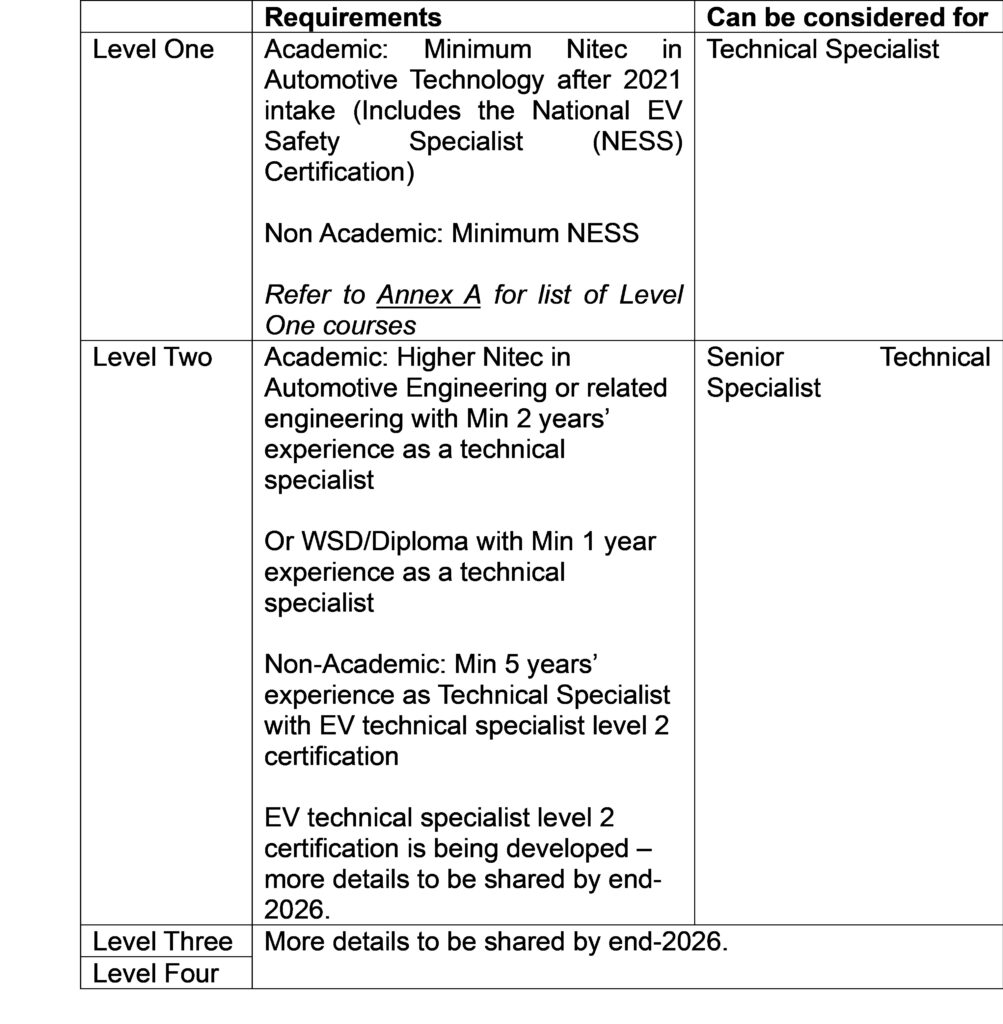
The Skills Pathway for EV Technical Specialists has been developed and validated by key stakeholders in the industry, including all four public bus operators, Singapore Bus Academy, employers in the automotive sector, and Institutes of Higher Learning (IHLs). The pathway features a structured four-tier progression from Technical Specialist to Engineer, with courses curated based on industry feedback and requirements. It provides a clear progression route for existing automotive technicians to enhance their capabilities, and for new technical specialists to be trained, strengthening Singapore’s EV workforce pipeline. Employers will be able to refer to this standardised skills pathway as a reliable hiring framework, enabling them to identify candidates equipped with the requisite competencies for entry and advancement within the EV maintenance sector.
Key features of the pathway include:
- Progression in Professional Development: Participants will progress through levels of technical competency and skills, and are ultimately eligible for recognition under the Chartered Engineering Scheme, with titles such as Chartered Technician, Chartered Technologist, and Chartered Engineer, based on their demonstrated expertise. The Skills Pathway for EV Technical Specialist is structured into four levels:
- Collaboration with Automotive Industry Leaders: Employers, such as Borneo Motors, BYD, Cycle & Carriage, and Komoco, will be actively involved, ensuring that individuals gain practical and job-ready skills that are aligned with industry needs.
- Meeting Industry Demand: Participating employers gain access to a broader talent pool equipped with EV maintenance skills and competencies, to support their business and innovation needs
Eligible individuals and employees will enjoy at least 50% course fee subsidies for SSG-approved courses identified under the Skills Pathway. The remaining out-of-pocket course fees can be offset through SkillsFuture Credit (SFC) for individuals or SkillsFuture Enterprise Credit (SFEC) for eligible employers.
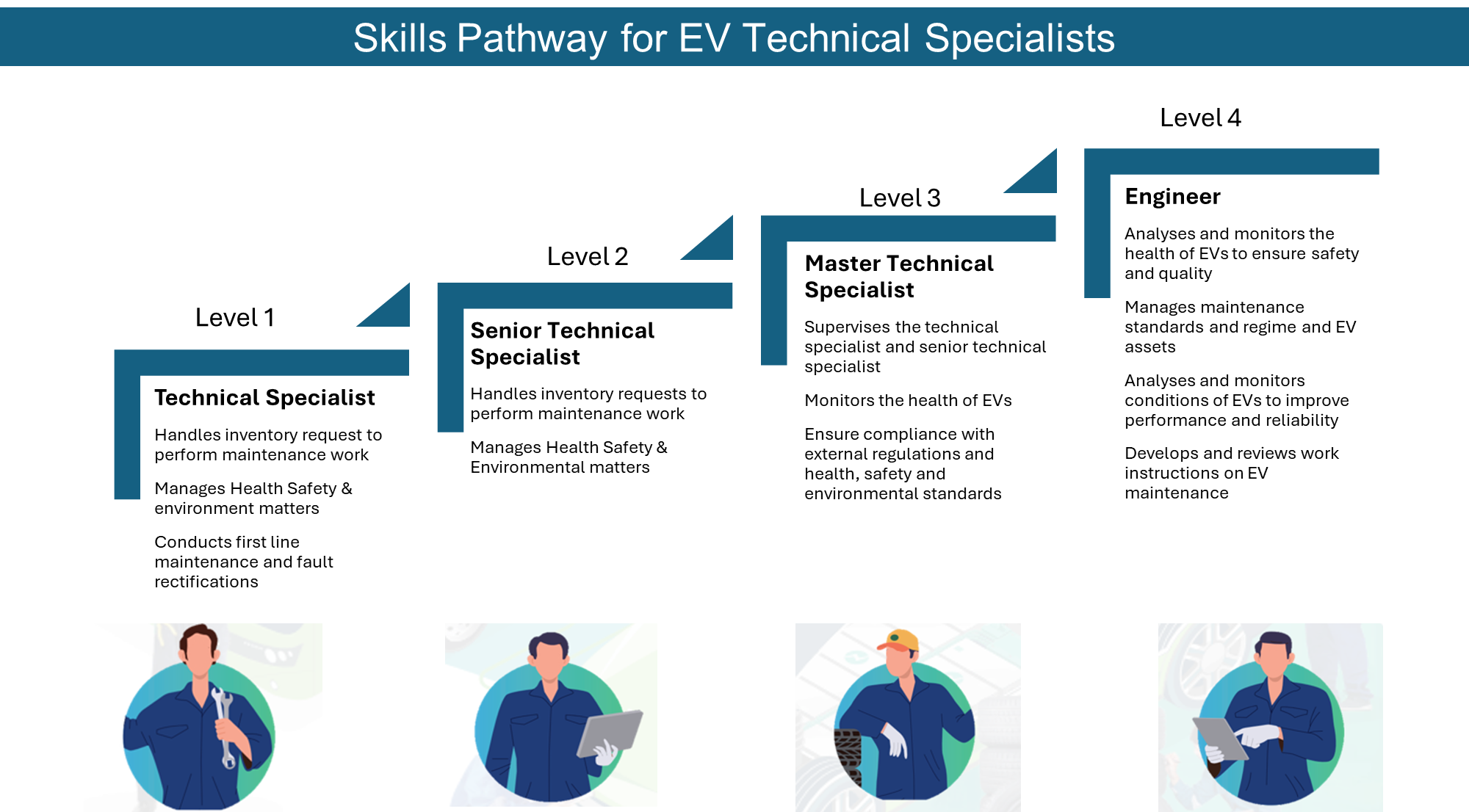
Available Courses for Level 1: Annex A: Available NESS Courses
FAQ 1: How many existing automotive specialists are there? Can we confirm that this new skills pathway is estimated to benefit around 2,000 specialists initially – both existing and new ones?
Singapore has about 2,000 automotive workshops and about 10,000 technicians. This new skills pathway will cover both existing and new specialists. We estimate that more than 2,000 workers could benefit initially, with scope to extend the pathway to more individuals depending on demand and industry needs.
FAQ 2: How exactly will employers such as Borneo Motors, BYD, Cycle & Carriage, Komoco be “actively involved”? Will they be expected to send all their staff for this skills pathway and receive certification?
Under the skills pathway, employers will be consulted and contribute feedback to shape the curriculum. They will recognise the certification in their recruitment process, including possible internship opportunities. For existing staff, employers are encouraged to support their participation in the certification programme. Employers will take into account employees’ completion of the programme when reviewing role progression opportunities and consider candidates who have completed the pathway for job opportunities in the organisation.
FAQ 3: Where can these specialists be employed after going through the skills pathway?
The Skills Pathway supports structured skills and career progression in EV maintenance roles; the competencies developed under the pathway are aligned with industry competency level requirements to support workforce readiness. Employers in the EV sector are strongly encouraged to consider specialists who have completed the skills pathway for employment opportunities in their organisations.
FAQ 4: What is the incentive for individuals to sign up for the NESS certification? And what is in it for an individual to sign up for this new skills pathway if they can sign up for other courses and already get a job as an EV technician?
The Skills Pathway for EV Technical Specialists offers a structured four-tier career progression route. While the NESS certification provides foundational safety knowledge for working with high-voltage EV systems, the Skills Pathway builds upon this to create a comprehensive professional development route.
Unlike standalone courses, this pathway provides a clear progression from Technical Specialist to Senior Technical Specialist and beyond. Participants can achieve recognition under the Chartered Engineering Scheme with titles such as Chartered Technician, Chartered Technologist, and Chartered Engineer. These are credentials that can enhance their career prospects in Singapore’s growing EV sector.
The pathway has been developed and validated by key industry stakeholders including all four public bus operators and major automotive employers like Borneo Motors, BYD, Cycle & Carriage and Komoco Motors. This ensures that the skills developed are aligned with industry needs and career advancement opportunities.
Participants can also enjoy at least 50% course fee subsidies for SSG-approved courses, with remaining costs offset through SkillsFuture Credit or SkillsFuture Enterprise Credit for eligible employers.
FAQ 5: What is the incentive for employers to get their employees on this pathway?
Employers gain access to a standardised, industry-validated framework for workforce development that addresses the demands of Singapore’s EV transition. The pathway has been developed and validated by major industry players including Borneo Motors, BYD, Cycle & Carriage and Komoco Motors, as well as all the four public bus operators.
The NESS certification has trained over 2,000 professionals since 2022, demonstrating strong industry demand. This expanded pathway builds on that foundation and addresses the shortage of skilled EV mechanics. This pathway professionalises the industry through structured career progression. Employers will have access to a broader talent pool with verified competencies that align with industry standards, while the four-level structured progression will attract more talent to the sector as reward and recognition rise in tandem with upskilling. This allows for better workforce planning and provides a reliable hiring framework to identify candidates with the requisite skills for different levels within EV maintenance operations.
The pathway will address the growing demand for skilled EV professionals as Singapore accelerates its transition to greener mobility across both private and public sectors. Eligible employers can also leverage SkillsFuture Enterprise Credit (SFEC) to offset training costs.
Sector Taskforce Members
Co-Chairman
Senior Director, National Transport Academy, Ministry of Transport
Mr Jeremy Yap
Group Director (Communications and Engagement), SkillsFuture Singapore
Mr Tan Tow Koon
Members
Chairman, CEB
Mr Lew Yii Der
SkillsFuture Singapore
Ms Xu Wenshan
SIT
Prof. Zhou Yi
Cycle & Carriage Singapore
Mr Thomas Tan
National Transport Academy
Dr Evan Gwee
ITE College West
Ms Choo Poh Ling
Land Transport Authority
Mr Roy Kee
Land Transport Authority
Mr Roshan
Land Transport Authority
Ms Goh Puay San
Singapore Army
Mr Calvin Seah
Singapore Army
Mr Jason Sim
Comfortdelgro Engineering
Mr Andrew Cheok
Singapore Polytechnic
Dr. Fred Wei
Comfortdelgro Engineering
Mr Tony Devaux
ChargeCo Global
Mr Richard Chin
BYD
Mr Roger Chan
SkillsFuture Singapore
Ms Jan Tan
ST Engineering
Mr Goh Meng Siang
Ngee Ann Polytechnic
Mr Tan Guangfan
Ngee Ann Polytechnic
Mr Steven Xu
Republic Polytechnic
Dr Quek Yang Thee
Hyundai Motor (HMGICS)
Mr Shaun Lim
NTUC Learning Hub
Ms Yoke Lian
SMRT
Mr John Tan
Land Transport Authority
Ms Jaslene Poh
Komoco Motors
Mr Steven Raj
Land Transport Authority
Mr Peter Lim
ST Engineering
Mr Theun Ong Ong
IES Secretariat
Mr Syed Mubarak Bin Subukutheen
IES Secretariat


